

You set a reminder, felt confident, and then completely forgot the task anyway. That frustration is far more common than people realize, and it happens even to the most organized parents, caregivers, and professionals alive. A single notification can vanish into the noise of a busy morning, a demanding workday, or the chaos of getting kids ready for school. This guide explains why relying on just one alert is a recipe for dropped balls, and how using layered reminders can transform your daily follow-through from hit-or-miss to consistently reliable.
Table of Contents
- The science behind multiple reminders
- When and why single reminders fail
- Benefits and strategies of layered reminders
- How to tailor reminders for your tasks and personality
- Why matching reminders to your real habits matters more than numbers
- Set up smarter reminders with Remoe
- Frequently asked questions
Key Takeaways
| Point | Details |
|---|---|
| Layered reminders matter | Setting multiple reminders reduces missed tasks and offloads memory stress. |
| Tailor for best results | Personalize timing, medium, and content to maximize effectiveness and avoid overload. |
| Single reminders often fail | Relying on a single alert is risky for tasks with complex timing or distractions. |
| Not all reminders are equal | Choose reminder systems and strategies that match your habits, context, and responsibilities. |
The science behind multiple reminders
Now that we've identified the common frustration of missed reminders, let's uncover what science tells us about why multiple reminders actually work.
The memory system responsible for "remembering to do something later" is called prospective memory. It's completely different from the memory you use to recall facts or past events. Prospective memory handles future intentions, like remembering to pick up a prescription at 3 p.m., send an invoice before Friday, or give your child their allergy medicine before school. Because you're not actively thinking about those tasks in the moment, they are especially vulnerable to being forgotten.
Research confirms that multiple reminders improve prospective memory performance by offloading the need to self-monitor future intentions, especially as delays grow. In plain language: the longer the gap between when you plan to do something and when it actually needs to happen, the more useful a well-placed reminder becomes. One reminder plugged in hours or days before is simply no match for that mental distance.

There's a practical reason reminders help beyond just jogging your memory. They also reduce the low-grade stress of tracking open loops. Constantly holding "don't forget this" thoughts in the back of your mind drains cognitive energy, what researchers call your mental space for punctuality. When a reminder system handles that monitoring for you, your brain can focus on what's happening right now.
Here's a quick look at how reminder frequency affects task accuracy:
| Reminder frequency | Task completion rate | Stress impact |
|---|---|---|
| No reminder | ~52% | High mental load |
| Single reminder | ~71% | Moderate mental load |
| Two or more reminders | ~89% | Low mental load |
| Layered, timed reminders | ~94% | Lowest mental load |
"Multiple reminders can improve prospective-memory performance by offloading the need to self-monitor future intentions, especially as delays grow." — PMC, 2025
The data tells a clear story. Each additional, well-placed reminder doesn't just add a redundant nudge. It covers a gap that the previous reminder could not.
When and why single reminders fail
Understanding the science behind reminders sets up the next question: why don't single reminders get the job done?
Think about the last time a calendar alert popped up and you swiped it away with every intention of handling the task "in a minute." That minute stretched into an hour, and the task never happened. Single reminders fail for several interconnected reasons.
Common reasons a single reminder falls short:
- Poor timing: A reminder at 9 a.m. for a 5 p.m. task is almost always forgotten by noon.
- Distraction at the moment of the alert: You're in a meeting, driving, or mid-conversation when it goes off.
- No context: A bare notification that just says "call doctor" doesn't tell you what number to dial or why it's urgent.
- Alert fatigue: When every reminder feels equal in urgency, all of them start feeling unimportant.
- Wrong channel: A push notification on a phone that's face-down in your bag does nothing.
Research adds an important nuance here. According to reminder effectiveness research, reminders help most when time-monitoring demands are high, but if you already have strong alternative cues, you may need fewer. The problem is that most daily life simply doesn't offer those strong cues. A bill due date doesn't announce itself. School picture day doesn't send you a text. Your medication doesn't rattle itself.
The false sense of security is arguably the biggest problem. Setting one reminder feels like the job is done. That psychological comfort actually reduces your natural vigilance, making you more likely to miss the task when the single alert fires at the wrong moment.
Pro Tip: For any task that has real consequences if missed, such as a payment, a medical dose, or a school pickup, always set a minimum of two reminders. One at least a day before and one closer to the actual deadline.
Exploring all-in-one reminder solutions can help you consolidate these alerts so they don't scatter across five different apps.
Benefits and strategies of layered reminders
With the pitfalls of single reminders clear, let's explore how layered reminder strategies take effectiveness to the next level.
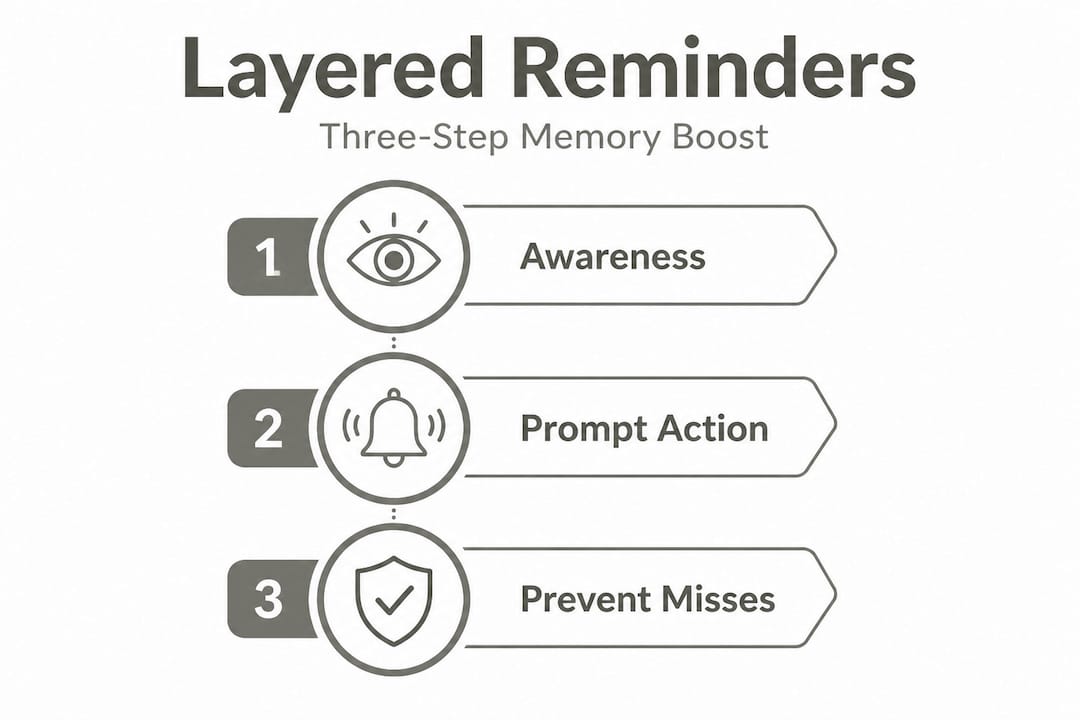
Layered reminders mean setting multiple notifications at deliberate intervals, each serving a different purpose. Think of it like a three-stage launch sequence: the first reminder plants the seed, the second prompts preparation, and the third fires at the moment of action.
A good multi-reminder system looks something like this for a school-related task:
- Day-before reminder: "Tomorrow is picture day. Pack the order form and make sure clothes are laid out."
- Morning reminder: "Today is picture day. Confirm your child is dressed and ready."
- 30-minute reminder: "Leaving soon? Double-check the order form is in the backpack."
Each stage does something distinct. The first creates awareness. The second prompts action. The third eliminates the chance of a last-minute slip. Layered reminders coordinated across people and devices are specifically recommended for busy families, and for good reason.
Here's how a single reminder compares to a layered approach across different task types:
| Task type | Single reminder outcome | Layered reminder outcome |
|---|---|---|
| Bill payment | Often forgotten if timing is off | Paid on time with preparation step |
| School event | Frequently missed or rushed | Attended with materials ready |
| Medication schedule | Doses skipped during busy mornings | Consistent adherence |
| Work deadline | Last-minute scramble | Completed with buffer time |
The benefits extend beyond just not forgetting things. Layered reminders actively reduce your mental load. Instead of holding complex task chains in your head, you trust the system to walk you through them step by step. This is especially valuable for caregivers managing both their own responsibilities and someone else's schedule simultaneously.
Role-based reminders take this a step further by tailoring alerts to the person and their specific responsibilities, so a parent gets a different prompt than a child or a co-caregiver.
Pro Tip: Assign each stage of a layered reminder a specific action, not just a passive notification. Instead of "dentist appointment tomorrow," write "Call to confirm dentist appointment and check co-pay amount." Actionable language increases follow-through dramatically.
How to tailor reminders for your tasks and personality
Knowing the potential of layered reminders, the next step is making those reminders actually work for your unique habits and daily life.
Here's an uncomfortable truth: a reminder system designed for someone else may actually make your situation worse. Reminder effectiveness varies significantly between individuals. Some people are helped substantially; others are annoyed or distracted, and reminder design changes outcomes. There is no one-size-fits-all solution.
Start by asking yourself these questions before building your reminder setup:
- Are you a morning or evening person? If your brain is sharpest at night, a morning reminder for a complex task may land when you're least receptive.
- What's your biggest distraction? Phone notifications, email, or audio alerts each carry different levels of interruption for different people.
- Is this a solo task or a shared responsibility? Tasks involving other people need coordinated reminders, not just personal ones.
- How complex is the task? A simple "take vitamin" needs one reminder. A car registration renewal that requires locating documents, visiting a website, and making a payment needs three or four.
Practical tailoring tips:
- Match the channel to your behavior. If you check email obsessively at noon, send a noon email reminder for afternoon tasks.
- Use audio for high-stakes reminders. Silent push notifications are the easiest to ignore. A chime or alarm creates urgency.
- Build on existing routines. Attach reminders to things you already do daily, like morning coffee or a commute. These natural anchors make reminders feel less intrusive.
- Review weekly. Every Sunday, scan your upcoming reminders and adjust any that no longer fit your week's rhythm.
- Shorten the gap for high-risk tasks. For tasks with serious consequences if missed, a 15-minute warning alongside a day-before reminder creates a safety net.
Personalized smart alerts make this customization far easier because they allow you to configure reminders by category, urgency, and delivery style all in one place.
A caregiver managing an elderly parent's medications needs reminders spaced very differently than a solo professional tracking project deadlines. A parent managing three kids' school schedules needs group-aware reminders that account for different drop-off times and extracurricular commitments. The common thread is intentional design, not just setting every task to remind you at 8 a.m. and hoping for the best.
Why matching reminders to your real habits matters more than numbers
Here's what most reminder productivity guides get completely wrong: they treat reminder quantity as the primary variable. More reminders equal better outcomes. That's not actually what the evidence says.
Research on heterogeneous reminder effects clearly implies that the goal is not to maximize the number of reminders but to match the reminder type, content, and timing to the specific person and task. You can set ten reminders for one thing and still miss it if none of them land at a moment when you can realistically act.
Think about what that means for how you structure your days. You don't need more alerts. You need better-placed ones. A well-timed single reminder at a natural transition point in your day, like when you're wrapping up work or walking to the car, is worth more than three reminders sent at arbitrary times.
The concept of "natural transitions" is underused and incredibly powerful. These are the moments in your day when your attention naturally shifts: waking up, finishing a meal, leaving the office, arriving home, putting the kids to bed. Anchoring reminders to those transitions means they arrive exactly when you have a moment to actually process and act on them.
We also believe strongly in the concept of "reminder maintenance." The biggest mistake people make isn't setting up a bad system initially. It's never revisiting it. Your life changes. Kids start new activities. Billing cycles shift. Job demands evolve. A reminder system that worked beautifully three months ago can become cluttered, irrelevant, or completely misaligned with your current routine. Building in a monthly review, even ten minutes, prevents that drift.
Exploring what makes reminders genuinely useful vs. just noisy is worth your time, as is understanding how to build a reliable reminder process for the documents and tasks that really can't be missed.
Technology should serve your routine. It should feel invisible when things are going well and only interrupt you when the interruption is genuinely warranted. That's the bar worth aiming for.
Set up smarter reminders with Remoe
You've got the strategy. Now you need a tool built to actually deliver it without juggling five different apps or rebuilding your system from scratch every time life changes.
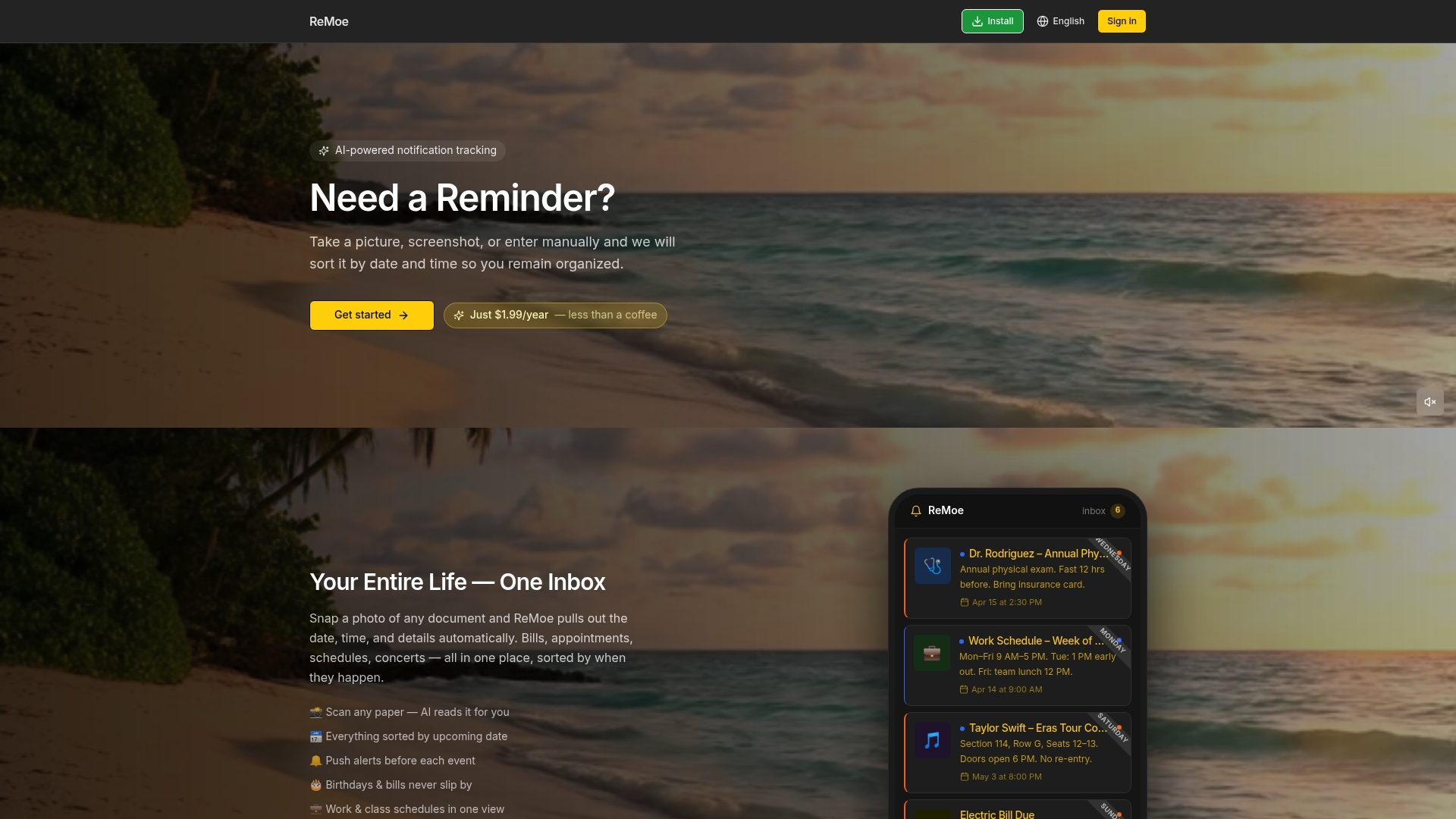
Remoe brings your entire life into one place, from medication schedules and bill due dates to school events and personal goals. You can build layered, multi-stage reminders with custom timing and delivery methods, all without switching between tools or losing track of what's most urgent. Whether you're a caregiver, a working parent, or a professional managing tight deadlines, Remoe's AI-powered reminder features adapt to your routine rather than forcing you into a generic template. Check out Remoe's pricing options and start with a free trial to see how much mental load you can actually shed.
Frequently asked questions
How many reminders are optimal for important tasks?
Most experts recommend at least two reminders: one well in advance for preparation and one close to the deadline for action. For complex tasks, three layered reminders coordinated across devices and people deliver the best results.
Can too many reminders make me less productive?
Yes. Alert fatigue is real, and receiving too many notifications can cause people to ignore all of them. Matching reminder frequency to your habits and task urgency is more important than simply setting more alerts.
How do I coordinate reminders for a whole family?
Use multi-stage reminders set at different time intervals and customize each notification for the relevant family member. Tools that support layered family reminders coordinated across shared devices reduce confusion and split responsibilities more clearly.
What if I already use calendars and sticky notes?
Supplement them with automated reminders specifically for tasks that carry complex timing or serious consequences if missed. Multiple reminders reduce the self-monitoring burden that manual systems like sticky notes require you to carry mentally.