
Most parents and caregivers use reminders for nearly everything. School pickups, medication schedules, bill payments, doctor appointments. Yet even the most organized, devoted caregiver still misses something critical. If that sounds familiar, you are not careless or forgetful. Your brain is simply overwhelmed. Reminder fatigue is the desensitization that happens when too many alerts pile up, making your mind tune out the very notifications that matter most. This article explains exactly what reminder fatigue is, why it happens, and how you can take back control of your attention.
Table of Contents
- Understanding reminder fatigue
- Reminder fatigue versus alarm fatigue: Key differences
- How reminder fatigue impacts parents and caregivers
- Best practices for preventing and managing reminder fatigue
- When should you worry? Signs you're experiencing reminder fatigue
- What most advice misses about reminder fatigue
- Smarter reminders, calmer life: Try ReMoe
- Frequently asked questions
Key Takeaways
| Point | Details |
|---|---|
| Reminder fatigue defined | Too many alerts can cause your brain to tune out even vital reminders. |
| Parents at high risk | Caregivers and parents are especially vulnerable to notification overload and its impacts. |
| Prevention strategies | Curation, automation, and escalation prevent important alerts from getting lost. |
| Learn from healthcare | Lessons from hospital alarm fatigue help inform better home notification practices. |
| Attention is a resource | Protecting your focus is more effective than adding more technology or reminders. |
Understanding reminder fatigue
Reminder fatigue is not the same as simple forgetfulness. Forgetfulness means you never encoded the information in the first place. Reminder fatigue means you received the alert and your brain still did not act. The distinction matters, because the solution is completely different.
The mechanics of this problem follow a predictable path. According to research on trigger fatigue, the stages move from full engagement, to selective delay, to reflexive dismissal, to systemic numbness, and finally to trigger blindness. At the earliest stage, you read every notification carefully. By the final stage, your thumb dismisses alerts before your conscious mind even registers what they said.
Think about what that looks like in a real household. You set a reminder to give your child their asthma inhaler at 7:00 AM. By week three, that alert sounds and you swipe it away while pouring coffee, fully intending to do it in a minute. Then the school rush happens, and the inhaler sits untouched on the counter.
Here is how the stages play out in practice:
- Engagement: You read, act on, and trust every reminder.
- Delay: You notice the reminder but postpone the action, telling yourself you will handle it soon.
- Dismissal: You dismiss the alert reflexively without fully reading it.
- Numbness: Multiple reminders pass without registering.
- Trigger blindness: Your brain has completely stopped responding to that type of alert.
| Stage | What you feel | What you do |
|---|---|---|
| Engagement | Alert, motivated | Act immediately |
| Delay | Mildly stressed | Postpone action |
| Dismissal | Slightly irritated | Swipe away without reading |
| Numbness | Emotionally flat | Do not notice alert at all |
| Trigger blindness | Nothing | Miss reminder entirely |
One practical way to fight back is to free up mental space by offloading routine mental tasks to a reliable system, rather than layering more alerts on top of an already overloaded mind.
"The brain is not broken when it stops responding to repeated signals. It is doing exactly what brains are designed to do: filter noise. The tragedy is when important reminders get filtered out alongside the noise."
Reminder fatigue versus alarm fatigue: Key differences
Healthcare professionals have studied a parallel problem for years. Alarm fatigue in hospitals happens when clinical staff receive so many device alerts that they start ignoring even the critical ones. Alarm fatigue in healthcare is caused by frequent non-actionable alarms leading to sensory overload, emotional strain, and reduced responsiveness. The numbers are staggering.
Research in critical care nursing shows that 80 to 99 percent of hospital alarms are false or non-actionable, meaning nurses can receive hundreds of meaningless alerts per shift before encountering one that requires real action.
Compare that to your phone on any given Tuesday. School notifications, medication reminders, calendar alerts for the dentist, a bill due alert, a weather warning, and three app badges all before 9:00 AM. Most of those are technically important. But your brain cannot tell the difference between urgent and merely scheduled.
| Feature | Alarm fatigue (healthcare) | Reminder fatigue (family life) |
|---|---|---|
| Cause | Too many non-actionable clinical alarms | Too many overlapping personal notifications |
| Who is affected | Nurses, clinicians, medical staff | Parents, caregivers, family managers |
| Main consequence | Missed patient deterioration signals | Missed medication, appointments, safety tasks |
| Typical fix | Protocol review, noise reduction | Notification audit, smarter automation |
| Emotional cost | Burnout, anxiety, stress | Irritability, guilt, decision fatigue |
What can parents and caregivers borrow from hospital protocols? Three clear lessons apply:
- Reduce total alert volume. Hospitals that cut non-actionable alarms saw staff responsiveness improve almost immediately. The same principle applies at home.
- Customize by criticality. Not every reminder deserves the same sound or urgency level. Critical medication alerts should feel different from a grocery list nudge.
- Centralize where possible. Scattered reminders across five apps is the home equivalent of every hospital device beeping independently. Using all-in-one reminders reduces the mental cost of tracking multiple systems.
How reminder fatigue impacts parents and caregivers
While alarm fatigue provides lessons, the effects of reminder fatigue on everyday family life create unique challenges, especially for parents and caregivers.

Research on digital fatigue and caregiver burnout shows that constant school messages, medical reminders, and calendar alerts cause measurable cognitive overload and reduced patience for parents. This is not about personality or willpower. It is a volume problem with real physiological consequences.
The situation becomes more serious in high-stakes caregiving situations. When you are managing a child's chronic condition, an elderly parent with dementia, or a family member who depends on precise medication timing, edge cases of digital fatigue show that irrelevant reminders actively worsen overload. Every unnecessary ping takes a small bite out of your capacity to respond to the alerts that genuinely matter.
It is also worth understanding the difference between information overload and actual reminder numbness. Information overload means you have more data than you can process. Reminder numbness means your nervous system has actively trained itself to stop responding to a specific type of signal. Both are harmful, but they require different fixes.
Here is how reminder fatigue shows up in real caregiving situations:
- Medication misses: You dismissed the alert and planned to do it later, but the day overtook you.
- Appointment no-shows: The calendar notification went off during a crisis moment and was swiped away.
- Safety lapses: Alerts about school pickup times, car seat checks, or home safety tasks get lost in the feed.
- Emotional withdrawal: You feel rising irritation every time your phone buzzes, regardless of what the notification says.
- Caregiver guilt: Missing a critical reminder leads to a spiral of self-blame that adds to overall stress.
If you manage reminders and child safety for your family, the stakes of reminder fatigue are not abstract. A missed medication dose or a forgotten car safety check are the kinds of consequences that no parent should face because their notification system overwhelmed them.
Pro Tip: Identify your top three non-negotiable alerts, those tied to health, safety, and time-sensitive obligations, and give them a distinct sound or visual cue. Mute or batch everything else into a daily digest you review once.
Best practices for preventing and managing reminder fatigue
Understanding the risks is only part of the solution. Now, let's discuss how to prevent or reverse reminder fatigue in practical terms.
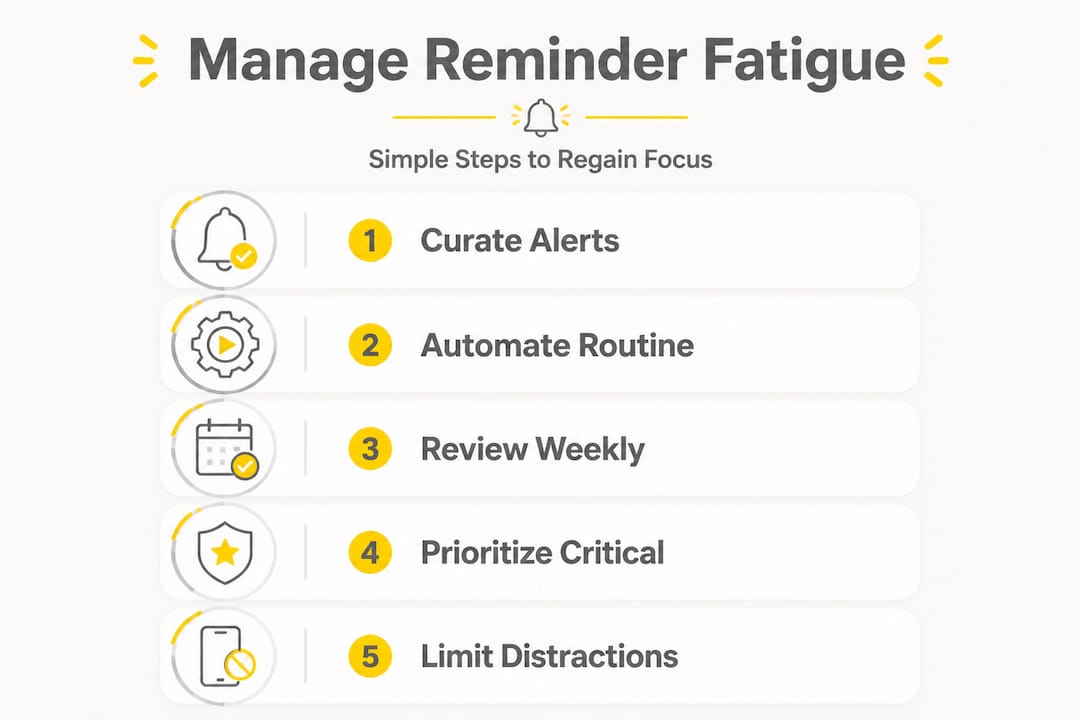
IBM's research on alert fatigue mitigation identifies several core methodologies: ruthless curation of notifications, deep customization, user training, protocol adjustments, and smart escalation rules. These same principles translate directly into family life.
For parents and caregivers, the most effective strategies focus on reducing interruptions through notification audits and automation for routine tasks like medication reminders, which prevents missing critical alerts for children or elderly family members.
Here is a step-by-step process to get your reminders under control:
- Audit every active notification on your phone. Open settings and go through every app one by one. Ask: "If I never saw this alert again, would something bad happen?" If the answer is no, turn it off or batch it.
- Sort remaining reminders by urgency. Health and safety alerts go to the top. Administrative tasks like bill payments go into a scheduled weekly review. Social and optional alerts get muted entirely.
- Automate routine, predictable tasks. Daily medication reminders, weekly bill checks, and recurring appointments should run on autopilot using smart alerts so your brain does not need to stay on manual patrol.
- Set escalation rules. If a critical reminder is dismissed without action, it should re-alert at a set interval. Non-critical reminders should not escalate at all.
- Batch lower-priority notifications. Instead of receiving twelve small reminders throughout the day, group them into one summary at a fixed time, like 6:00 PM after dinner.
- Build a daily habit checklist for recurring tasks. A visible checklist removes the need for multiple separate alerts and gives you one place to confirm what has been done.
The key insight is that fewer, better reminders outperform more reminders every single time. Quality over quantity is not just a preference; it is how human attention actually works.
Pro Tip: Set a ten-minute calendar block every Sunday to review your notification settings. Remove anything that fired during the week but did not require action. This simple habit prevents alert buildup before it reaches the numbness stage.
When should you worry? Signs you're experiencing reminder fatigue
Even with good strategies, it is easy to slip into reminder fatigue without noticing. Here's when to take action.
In primary care settings, clinical alert fatigue leads physicians to disregard pertinent alerts and is directly linked to burnout. The same pattern occurs at home. When caregivers hit the numbness stage, the emotional cost shows up as irritability, exhaustion, and guilt, not just missed reminders.
Here are five signs you may already be experiencing reminder fatigue:
- You feel a flash of annoyance every time your phone buzzes, regardless of what the notification is. This is a signal that your nervous system has associated alerts with stress rather than helpful prompts.
- You frequently dismiss reminders without reading them fully. If your thumb moves faster than your eyes, you are in the reflexive dismissal stage.
- You have missed medication doses, appointments, or safety tasks recently, even though you had reminders set for them.
- You feel persistent low-level anxiety about whether you have missed something important, even when you cannot identify what it is.
- You are adding more reminders to compensate for the ones you are missing. This is the most dangerous pattern because it accelerates the overload.
If you recognize three or more of these signs, it is time to take action rather than adjust minor settings. A full audit and reset of your multi-reminder systems is the right first move, not adding another app or setting another alarm.
What most advice misses about reminder fatigue
With practical advice in hand, let's now confront the bigger picture and what is often overlooked in mainstream guidance.
Most articles about reminder fatigue treat it as a settings problem. Turn off this app. Set that alert to silent. Use a different notification sound. These tactics are useful but they miss the root cause entirely.
The real issue is that attention is a finite resource, and most of us have never consciously treated it that way. We add alerts the way we add subscriptions, casually, one at a time, never stopping to assess the cumulative weight.
Here is what we have found working with families on reminder management: the households that struggle most are not the disorganized ones. They are the highly motivated ones, where one parent has set up an elaborate notification ecosystem trying to keep everything running perfectly. The system becomes so dense that it collapses under its own weight.
Research on reminder adherence confirms this complexity. Reminders do boost medical adherence, but the relationship is not linear. When memory costs and annoyance costs rise together, the benefit of additional reminders actually decreases. In other words, past a certain threshold, adding reminders actively hurts compliance.
We saw this pattern with one family managing a parent with early-stage memory loss. Both adult children were sending reminders through a shared smart speaker. The result was a storm of overlapping alerts that the parent began ignoring entirely because no single voice felt trustworthy. When they switched to role-based reminders where one designated person managed all alerts through a single channel, adherence improved within two weeks.
The lesson is not technical. It is relational and psychological. Families need to treat attention as a shared resource and build household habits around protecting it. One system, one voice, clear priorities, and regular reviews. No tactic replaces that foundation.
Emotional depletion is the hidden cost that never gets discussed. Every unnecessary alert drains a small amount of emotional energy. Over months, that drain becomes exhaustion. The fix is not more efficient notifications. It is a fundamental shift in how your household values and protects focus.
Smarter reminders, calmer life: Try ReMoe
If reminder fatigue has been quietly eroding your confidence as a caregiver, you deserve a system built around how attention actually works. ReMoe was designed specifically for parents and caregivers who need their most important reminders to land every time, without drowning in the noise.
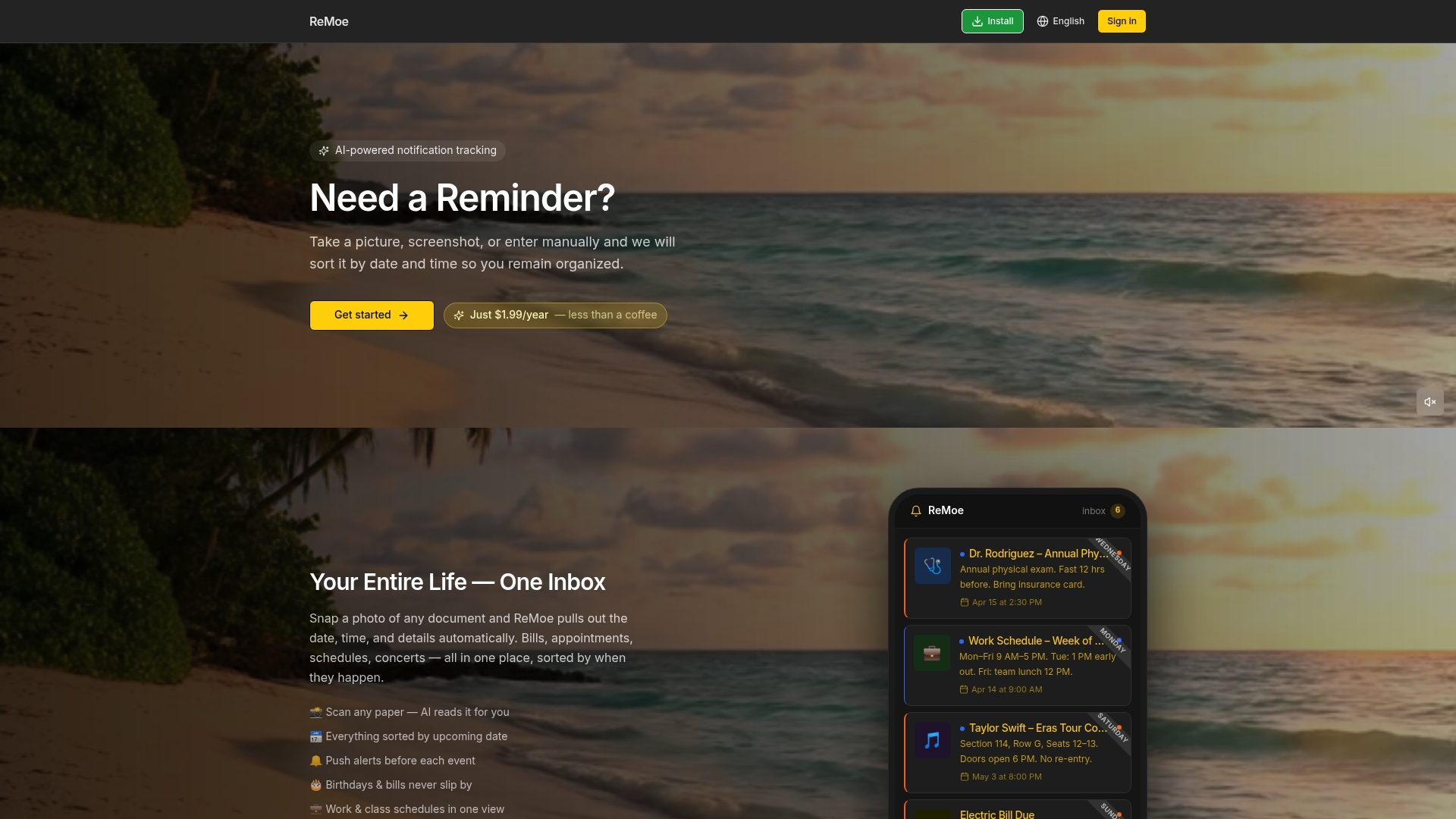
With the ReMoe AI app, you can group reminders intelligently, automate routine tasks like daily medication schedules or bill due dates, and set smart escalation rules so only the truly critical alerts break through. Everything from your child's school schedule to your elderly parent's prescription refills lives in one place, organized, prioritized, and calm. Check out affordable pricing options built for families who want better balance without complexity. Your attention is worth protecting.
Frequently asked questions
What is the main cause of reminder fatigue?
Having too many notifications and repeated alerts causes your brain to tune out even important reminders, a process described as desensitization from excessive alerts that leads to reflexive dismissal of critical notifications.
How can I prevent ignoring important reminders?
Prioritize must-have alerts, automate routine notifications, and regularly review your settings to keep only crucial reminders active, following notification curation methods like ruthless audits, deep customization, and smart escalation rules.
Does reminder fatigue affect medical adherence?
Yes. While reminders do boost adherence in general, adherence research confirms that annoyance and memory costs from too many reminders can actually reduce their effectiveness and cause missed medication or appointments.
Who is most at risk for reminder fatigue?
Parents and caregivers managing frequent alerts for children, elderly family, or chronic illness are most vulnerable, as digital fatigue research shows that constant school messages, medical reminders, and calendar alerts cause measurable cognitive overload and reduced patience.
What is the difference between alarm fatigue and reminder fatigue?
Alarm fatigue is common in healthcare settings caused by frequent non-actionable clinical alarms leading to sensory overload, while reminder fatigue impacts daily personal life through the same mechanism of excessive, often non-actionable, notifications overwhelming attention.